

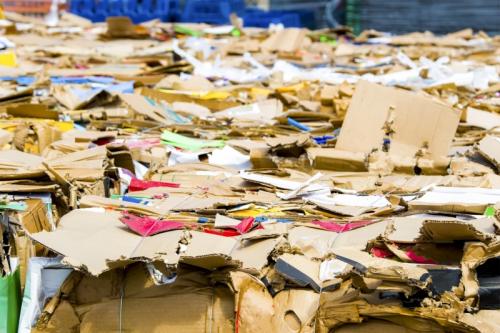
Paper and cardboard can be recycled countless times, but not indefinitely. Paper recycling must therefore be carried out efficiently, starting with separate collection, which must be carried out consciously, in order to extend the life of the cellulose. Differentiating paper allows us to facilitate the creation of a new secondary raw material (MPS), ready to be reused: from recycled paper, in fact, it is possible to obtain other paper with which to generate notebooks, notepads, diaries, post-its, photo albums, kitchen towels, envelopes and various bags, but not only. Thanks to the recovery of paper, we also obtain cellulose fibers to be used in green building: a truly precious resource, especially in Italy, where raw materials are not so abundant. In addition, using recycled paper in this process provides the cellulose fibers necessary to create new paper and this triggers a virtuous circle of reuse, also known as the “recycling cycle”. In short, paper – within certain limits of course – is capable of regenerating itself “by itself”. But what happens to paper after private individuals carry out the sorting process of separate waste collection?
So let’s see what the procedure consists of, step by step.
Step 1
Initially, the paper is screened because foreign objects, such as plastics or types of non-recyclable paper, often end up in the middle.
Step 2
Later, the larger cartons are separated from the plain sheets. This action is carried out by a roller system, which separates the packaging cardboard from the smaller paper.
Step 3
Once separated, the sheets of light paper pass on a mobile belt, which runs in front of operators who manually remove the impurities present and obtain clean raw material: this result is the so-called MPS, which together with that coming from the industrial waste selected at the source, is pressed into large bales, stored and shipped to paper mills.
Step 4
Once in the paper mill, just as happens in the process of creating normal paper, through the use of cellulose bales, the waste is thrown into pulpers: large tanks of hot water, where it is finely chopped, thanks to a swirling motion that pulps the paper and transforms it into a sort of mush. Subsequently, with a strong magnet, the metal objects present, such as paper clips, are attracted and eliminated. As for glue and some pieces of fibers and materials such as paraffin, the elimination takes place through a series of vibrating screens with progressively larger meshes. If the aim is to obtain a paper with a high degree of whiteness, the subsequent deinking process will also eliminate any inks, varnishes or enamels present.
Step 5
From the previous treatments, a kind of mixture will be obtained that will be refined to strengthen the bonds between the fibers and optimize their solidity and resistance. This is a process common to all types of paper, in order to increase the contact points between the fibers, making them elastic and flexible. Then, to bind the fibrous raw material, materials such as additives are mixed. At that point, the mixture is sprayed on conveyor belts that take it to the “paper” machines, where it is evenly distributed on a felt to be compressed by the use of hot rollers, in order to allow the water to escape. Once the dough has dried, the thicknesses and formats of the new paper are made.
This procedure makes it possible to counteract the environmental impact of the production and use of paper and cardboard. It does this in three ways: it reduces the use of virgin fiber and the emissions related to its production, it decreases the amount of waste in landfills and it reduces emissions related to water and electricity consumption. This is why it is important that the upstream sorting is done very carefully.
However, when large quantities of paper and cardboard are consumed, it is not always easy to identify the right location for this waste: in fact, some can be misleading. Receipts, for example, should never be thrown away with paper, because they are made with thermal paper that generates problems in recycling. Or again, certain supports for professional printing (such as photographic paper), are subject to particular forms of disposal compared to normal paper. Conversely, however, a wide variety of paper and cardboard derived from natural cellulose can be easily collected and recycled. Not to mention cardboard packaging with food residues that cannot be thrown away in the normal separate paper collection, because they create difficulties in the recycling process. It should also be emphasized that there is also paper that is difficult or even non-recyclable, such as paper handkerchiefs, greaseproof paper and paper soiled with poisonous substances, such as paints or solvents.
Individuals and companies do not always have the necessary tools to provide for the correct management of waste such as paper and cardboard in compliance with the law and in the name of energy saving. In case of difficulties in identifying the types of paper – and therefore of treatment – or of the need to dispose of large quantities of paper or simply of doubt on how to do it correctly, it is possible to request EuroCorporation an analysis of the type of paper or cardboard to be disposed of. Our technicians will identify the right attribution, for each waste, of the corresponding CER classification code, thus starting the appropriate disposal procedure.
EuroCorporation can identify the destination of your paper and cardboard waste and can also proceed with the collection and treatment of it, according to the methods provided for by law and most appropriate for the respect of the environment.


