

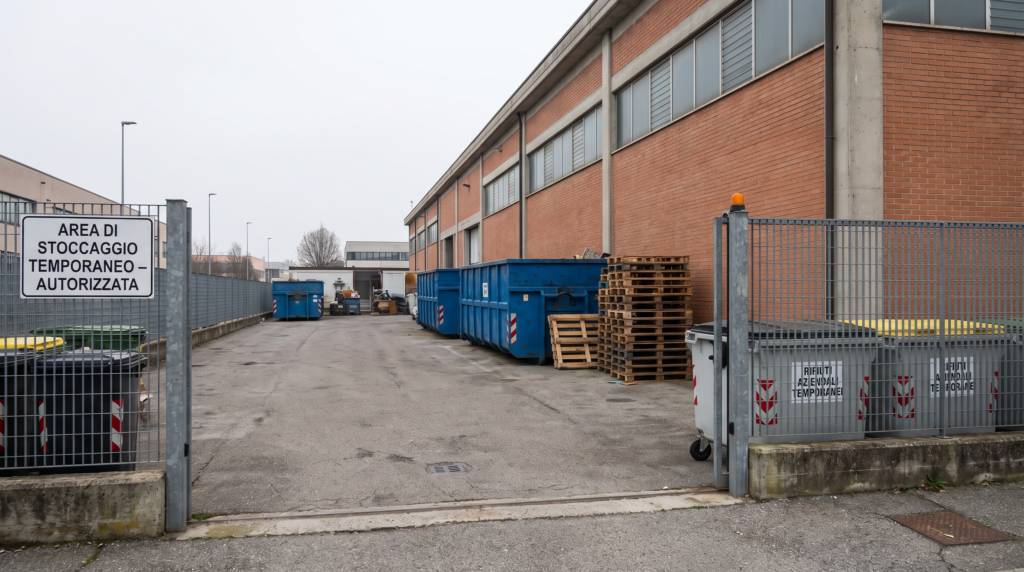
What is temporary storage (and why does it affect you)
Every company that produces waste accumulates it for a certain period before collection: that grouping, if it complies with precise conditions, is called temporary storage before collection and does not require any authorization. It is a valuable simplification — the alternative would be to authorize every company yard as a plant — but it is bound to precise rules on where, how much and for how long. And when the rules are broken, simplification is also skipped: what was a lawful deposit becomes illegal management.
The regulatory reference is art. 185-bis of Legislative Decree 152/2006, introduced by Legislative Decree 116/2020 and last amended by Law 182/2025.
Where: the place of storage
The general rule is only one: the temporary storage takes place in the place where the waste is produced, understood as the entire area where the activity that generated the waste takes place. The company perimeter, therefore — not a rented warehouse two municipalities away. It is not enough that an area is “at the disposal” of the company: it must be the production site.
The exceptions are exhaustive and concern three specific cases: agricultural entrepreneurs, who can deposit at the site in the legal availability of the agricultural cooperative or agricultural consortium of which they are members; distributors, for waste subject to extended producer responsibility only, at the points of sale or their appurtenances; construction and demolition waste, at the areas pertaining to the points of sale of the related products. If your situation is not one of these, the answer to the question “can I take them to the other location?” is no.
How much and for how long: the two alternative criteria
The rule provides for two criteria to choose from, one temporal and one quantitative:
Time criterion: start for recovery or disposal at least quarterly, regardless of the quantities in storage. Easy to manage: four collections a year, calendar in hand.
Quantitative criterion: start when the deposit reaches a total of 30 cubic metres, of which a maximum of 10 cubic metres of hazardous waste. If the quantity does not exceed this limit in a year, the deposit may not last more than one year.
Pay attention to the point that escapes us most often: the ceiling of 10 cubic meters for hazardous is valid within the overall limit of 30, not in addition. A company with 25 cubic meters of non-hazardous and 8 cubic meters of hazardous is above the overall limit (33 cubic meters) even if below that of dangerous.
How to choose? It depends on the actual production. Those who generate little waste often find the quantitative criterion cheaper: it is called the withdrawal when the deposit is approaching the threshold (or at the end of the year). Those who have constant flows generally prefer the quarterly cadence, which is scheduled and does not require monitoring of volumes. The important thing is to choose a criterion and be able to demonstrate compliance with it: dates of withdrawals for the storm, documented estimate of volumes for the quantity.
The conditions to be respected at all times
Whichever criterion is chosen, paragraph 2 of art. 185-bis establishes the management conditions: grouping by homogeneous categories, in compliance with the relevant technical standards; for hazardous waste, compliance with the rules governing the storage of hazardous substances contained therein; packaging and labelling in compliance with the rules on hazardous substances. This is where incompatibilities between substances come into play: separating what cannot be together — acids and bases, oxidants and flammables — is part of the technical storage standards.
Translated into concrete organization: one container for each EER code, never mix (the prohibition for hazardous products is expressed, art. 187), area identified and protected from atmospheric agents, flooring and containment suitable for liquids, and legible labels on each container. On the identification of containers, we refer to the labeling guide: this is the most controlled aspect during inspections.
What an inspection looks at (in order)
The experience of the controls is quite constant: first the area — where it is, how it is protected, what it really contains; then the containers — labels, codes, state of conservation, signs of mixing; then the cross-referencing with the documents — registers and forms must tell the same story as the drums present; finally, the times and quantities — how long that material has been there, how much there is. An orderly deposit with deposit start dates noted on the containers answers half of the questions on its own.
What happens if you exceed the limits
Outside the conditions of art. 185-bis, the deposit loses its simplification and falls into the sanctioned cases: uncontrolled deposit — which after the 2025 reform, for hazardous waste, is a crime punishable by imprisonment (art. 255-ter), with specific penalties for business owners — or unauthorized management (art. 256). The complete picture is in the sanctions guide. The distance between a compliant deposit and a criminal complaint can be a matter of cubic meters or weeks: this is why it is better to organize, not improvise.
How to organize yourself in practice
Three steps make the temporary storage manageable without worries: dedicated containers correctly labeled for each EER code; an identified, covered and protected area, with the incompatibilities respected; scheduled collections calibrated to the chosen criterion. EuroCorporation provides the containers in accordance with the law, plans the collections on your real production and verifies with you the compliance of the deposit during inspections — so the inspection, when it arrives, finds what it needs to find.
Questions Answers
Does temporary storage require authorization?
No, if it complies with all the conditions laid down: the law expressly says so (art. 185-bis, paragraph 3). Outside the conditions, however, it becomes unauthorized management.
Can I move waste to another location in my company?
In general, no: the rule is storage at the place of production, understood as the entire area of the activity. Deposits in different places are allowed only in the mandatory cases provided for by the law (agricultural supply chain, distributors for waste in extended responsibility, construction and demolition waste at points of sale).
Does the one-year limit always apply?
The annual cap is provided for as part of the quantitative criterion: if you choose the temporal one, quarterly withdrawals absorb the issue. In any case, no waste should age in storage: the more time passes, the more difficult it becomes to demonstrate its correct management.
Who controls the temporary storage?
Environmental control bodies during inspections: area, containers, labels, records and times are the points most often checked.
Do you want an inspection-proof temporary storage? Containers, labels and scheduled collections: take care of all our hazardous waste disposal service for companies. Request a free quote.


